On the Pleasure of Writing in Swedish
This blog has always been in English, because I want my foreign friends and others around the world to be able to read my posts. Likewise, academic life in Sweden is increasingly becoming oriented towards English as the standard language, especially when it comes to publications. But there is nothing that I love as much (well, intellectually speaking) as writing in Swedish! It’s of course nice – and nowadays totally necessary – to be able to publish books and articles in English as an academic lingua franca. But I’m sometimes surprised how many of us unthinkingly turn to this foreign language to express ourselves as often as we can. I’m firmly convinced that Swedish scholars need to continue expressing themselves in Swedish as well.
Perhaps that’s an impossible equation? I mean, to write in both English and Swedish. Our time is limited and if we prioritize writing a piece in Swedish it means that we can devote less time to our English-language works, which we need to focus on to stay alive in a competitive academic world. But especially in contexts where my research is linked to burning present-day issues whose relevance go far beyond the academic realm, I find myself yearning to write in Swedish, my native language. I also see it as an essential task to act as a mediator between what’s happening in the international academic realm and what’s being discussed locally in Swedish society. Moreover, and needless to say, on a deeper level, writing in Swedish is a fundamental way for us to contribute to keeping our national culture and identity alive.
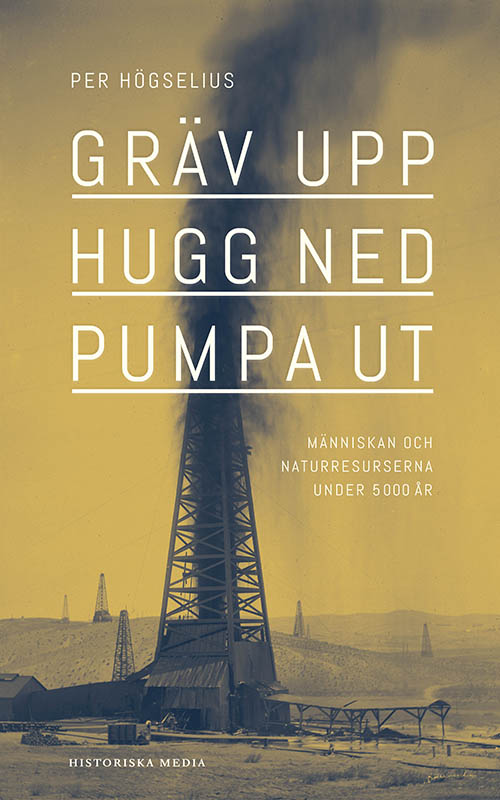
This autumn I was happy and proud to see my new book in Swedish being published: “Gräv upp, hugg ned, pumpa ut: Människan och naturresurserna under 5000 år“, a kind of popular world history of natural resource extraction and use. The book consists of a longer introductory essay and 13 short chapters, each of which discusses a particular natural resource in global historical perspective: water, wood, salt, gold, iron, coal, sand, ice, aluminium, oil, natural gas, uranium and rare earth elements. It was great fun to write and I was motivated primarily by a strong conviction that this is something that everyone should really know about. The book is intended for a broader, general readership and partly builds on shorter texts that I have written over the years for Swedish-language newspapers and magazines such as Svenska Dagbladet and Forskning & Framsteg. The book also exemplifies how I try to promote the interaction between international academic discourses and local, Swedish societal debates. It is based partly on my own primary research in the fields of energy history and extractivism, but to a great extent also on numerous remarakable works that scholars around the world have produced, from Daniel Yergin’s classical oil history epos “The Prize” to Joachim Radkau’s “Holz: Wie ein Naturstoff Geschichte schreibt”. The latter title may further serve as a reminder of the challange of taking into account, to the extent our language skills permit, key academic works published in languages other than English.
Taking inspiration from Radkau and others, my next Swedish-language book project is a caleidoscopic history of wood, with a particular emphasis on Sweden’s multifaceted experiences with this raw material. Stay tuned for its publication in autumn 2026!
 Per Högselius